
- 3D Printing (6)
- A Bogus Journey (2)
- Defies Categorization (3)
- Energy (18)
- Finance and Economics (3)
- Flying (1)
- Frozen North (1)
- Metablog (5)
- Nerdgasm! (7)
- Optimistic Signs (11)
- Parenting (3)
- Pedal Power (5)
- Politics (1)
The More I Find Out, The Less I Know
Categories

Energy
Energy-related topics, especially alternative energy and energy efficiency
Half a Year of Solar (almost)
Fri, 12/26/2014 - 18:04 — Shivering TimbersOur solar panels were activated five months ago, at the end of July. That was a couple months later than we had been hoping, but the modules we ordered were in short supply at the time.
Since then, perhaps the most remarkable thing about living with solar power is just how drama-free the whole thing is. It took a fair amount of effort and planning to get the system installed. But now that it's in place, it just sort of sits there and generates power.
Now that we've had the solar panels in place for almost half a year, here are a few observations in no particular order:
- Probably the coolest part of the whole system is not the solar panels but the power monitoring system. This lets us view, in real time, how much power we're using and how much we're generating. This turns out to be a great motivator to turn off lights when we leave the room and otherwise look for ways to save energy. We have cut our household energy consumption by about 10% just thanks to having this tool.
- The TenK modules are performing as advertised when we have partial shade. One reason for selecting this brand was that the roof over our garage (which is where half the solar panels were installed) gets a lot of dappled shade in the winter months, and TenK modules are designed to be highly shade tolerant. Most solar panels will lose a large fraction of their power output if there's even a small patch of shade, but the TenK modules keep generating under these conditions.
- Speaking of shade....solar panels don't generate much power when it's cloudy, and we're in the middle of the cloudiest stretch of weather in Minneapolis since the 1960's. November and December are normally the cloudiest and darkest months of the year, but we have literally had only two even partly sunny days in the past three weeks.
- However, despite the clouds we have had relatively little snow cover. Since it's impossible to clear the snow off half of the solar panels, persistent snow cover is also pretty bad for our power production.
- Speaking of snow, when the panels are covered in snow and the temperature gets above freezing for a few hours, all the snow and ice tends to slide off in a big clump. From inside the house it sounds like being underneath an avalanche (which is pretty much what it is).
- We've had a few neighbors ask about solar, but it happens that ours is one of the few houses in the neighborhood that's suitable for solar panels. That's the downside to living in an area with a lot of big trees.
Our Solar System Takes Shape
Sat, 04/05/2014 - 13:47 — Shivering TimbersIn the past few months we have finalized the basic design of our solar power installation.
Our system will have two arrays, one over the garage and one on the main part of the house. Each array will have eight 410-watt solar panels from a local manufacturer called TenK. These will feed 12 microinverters made by Altenergy Power Systems. The total nameplate capacity of the system is 6.56kw, but because the two arrays will face different directions it will never produce that much power at any given time. Instead, with a southwest and a southeast array, one will catch more morning sun, and the other will catch more afternoon sun.
The estimate is that this system will produce, on average, about 5,800 kWh per year. This is relatively low production for a system this size in this area, and the lower production is mostly because of partial shading on the arrays, especially in winter. The garage array, in particular, is estimated to produce almost no power in the month of December because the garage roof will be mostly shaded by the rest of the house. That's not such a great loss, though, since Minnesota gets relatively little solar energy in December anyway.
We chose this system because of a very generous incentive program Minnesota is offering for solar panels made in Minnesota. For the first ten years the system is in production, we will get an incentive payment of $0.29/kWh for all the power it produces. This is in addition to the net metering credit which is currently about $0.12/kWh and will increase as electric rates go up. The Made in Minnesota incentive is paid for through a conservation program established several years ago by the state which requires electric utilities to set aside a small percentage of their revenue towards energy conservation programs.
The Made in Minnesota incentive is so generous that we expect this system to pay for itself in under ten years, despite the shading on our site and the slightly more expensive panels from TenK. Our benchmark for making solar worthwhile is that the system pays for itself within its lifetime (25-30 years), so this system meets that threshold by a large margin.
TenK Modules
The TenK solar modules are a new and innovative product, which was another reason I liked this option. Some people might read "new and innovative" to mean "unproven and risky," especially for a major capital investment expected to last decades. For us, however, since one of our goals is to learn and explore solar energy, the chance to work with a product taking a new approach to solar power is definitely a bonus.
Traditionally, solar panels are very dumb devices. The basic solar module consists of a few dozen photovoltaic cells sealed in a weatherproof enclosure and wired together with a couple diodes. In many cases, the panel manufacturer doesn't even make the solar cells, they just buy the components and assemble them into the final package. That's part of the reason why there are so many solar panel manufacturers and it's such a low margin business. There's been fairly little technology in the module itself, and all the magic happens in manufacturing the photovoltaic cells and in the inverters and controllers.
TenK, on the other hand, takes a very different approach. They sell "smart" panels which incorporate the MPPT electronics (which maximizes the harvest of power from the solar cells) into the module itself, and do a DC-to-DC power conversion to control the output of the module.
This allows them to get more power from the system in situations where a traditional module performs poorly (such as when half the module is shaded and the other half is in the sun). It also allows them to use a power bus for connecting the modules to the inverters, which makes it practical to generate a lot of power but keep the DC voltage at or below 60V.
The low voltage DC bus is important because high voltage DC (traditional photovoltaic strings can operate at hundreds of volts) is dangerous and requires special equipment to manage. The TenK modules also have built in ground fault protection, so if there's a short circuit in the power bus the modules shut down automatically.
So (in theory) the TenK "smart" modules should allow us to get more power from our system (especially in December), and while the modules themselves are more expensive, the rest of the installation is simpler. The total system price quoted by our installer for the TenK system was about 10% higher per watt than what we were quoted for a more traditional system built around "dumb" panels, but it's possible we will actually get 10% more power from this system than from a similarly sized array from another manufacturer
The risk, of course, is that TenK goes out of business and our modules break earlier than expected. With a more complex module there's more risk something will go wrong and the system will need to be repaired; and the solar module business is notoriously brutal.
In the near term, TenK seems fairly stable since they very recently raised a substantial amount of money from investors. I spoke to some of the company's early customers and they were all pleased, so I'm comfortable that they will be around to fix any problems which develop in the first few years.
Next Steps
One downside to the TenK modules is that the product is currently in short supply. Our installer advised us that we can expect the modules to be available in June, which is 2-3 months from now. We're hoping that won't get further delayed, since we want to take advantage of the most productive solar months of the year.
In the meanwhile, we're starting on the paperwork for the utility approvals and the solar incentive program, and looking at what work we can get done in advance so that when the solar panels arrive we can get into production as fast as possible.
Energy Storage: Potential Game-Changer for Renewables
Sun, 02/16/2014 - 18:41 — Shivering TimbersSolar power has reached the point where, for ordinary consumers, it's generally about the same price as power from the electric company.
Wind energy has reached the point where, for utilities, it's generally about the same price as generating power from fossil fuels.
Not surprisingly, then, both residential solar and utility wind power are growing very fast in the U.S. I've seen some analysis showing that essentially all the net new generating capacity being built in this country is coming from renewable sources. I don't know how credible this is, but whether it's true or not today, it will be true in the not very distant future.
Solar and wind energy can continue to grow like this for many years, since they still represent a very small portion of our total electric generation. But the growth of renewable energy will eventually be limited by the fact that these energy sources are inherently intermittent. The sun doesn't always shine, and the wind doesn't always blow, and there's no way to control when you get power.
The problem is that electricity needs to be generated at the same time it is consumed. The power grid doesn't store power, it just moves it from one place to another.
Right now, storing electricity is a lot more expensive than generating it. In our neighborhood, it costs about $0.12/kWh to buy power from the electric company. Rechargeable batteries, on the other hand, cost (on the cheap end) around $0.50 for every kWh you use because the battery has a limited number of charge cycles before it needs to be replaced.
Given the cost of storage technology today, it is almost never economical to store excess renewable power for later use, even if the power is free (the only exception is if there are no other power generation options available--for example, a cabin in the woods). That means that, with today's technology, wind and solar power can't supply anything close to the majority of our electrical needs, since the power simply won't be generated at the right time.
An inexpensive way to store excess power for later use would radically change the economics of renewable energy. Lots of smart people are working on this problem, and there are several different approaches which could bear fruit.
Improvements in Battery Technology
Traditional batteries are the simplest way to store electricity for future use, but today's technology is simply too expensive for large quantities of power (except in specialty applications like electric cars). There's a lot of research into novel chemistry, better physical designs (including lots of nanotechnology), refinement of approaches like flow batteries, and so forth.
In order to become economical, there needs to be at least an order of magnitude improvement in the cost of large batteries per lifetime kWh (where the lifetime kWh is the capacity of the battery multiplied by the number of charge cycles before the battery has to be replaced). The good news is that there doesn't seem to be any fundamental limitation to getting there--it's possible to build rechargeable batteries from relatively cheap and abundant raw materials. The bad news is that the cost of battery technology seems to be dropping only relatively slowly, and it will take a long time to cut the price by an order of magnitude without a major breakthrough.
Non-Chemical Energy Storage Media
There have also been a lot of novel energy storage approaches proposed, including:
- Pumping water up a hill and using it to generate hydroelectricity
- Filling giant underground caverns with compressed air
- Using large banks of supercapacitors to store electricity
- Spinning large flywheels
These techniques are certainly able to store energy and make it available on demand. Bringing them up to utility-scale (or even power-a-house scale) is a challenge, though. Pumping water and compressing air are both relatively inefficient and only work in certain geographical locations. Flywheels, compressed air, and supercapacitors have a safety issue, in that if Something Goes Wrong they can release a huge amount of energy uncontrollably fast (that is to say, they can explode). To my knowledge, none of these schemes has made it past small scale pilots, though they sound promising on paper.
Upconverting Excess Electricity to Fuel
One really intriguing approach is to find a chemical process which can be used to produce liquid fuel using electricity, and using the fuel produced to power vehicles or electric generators for times when the renewable power isn't available.
This is attractive for several reasons:
- It turns excess renewable power into a valuable commodity
- It allows renewable power for cars, trucks, and airplanes, where renewable power isn't really an option
- Liquid fuels are easy to store and transport in large quantities, making it possible to use renewable power in times and places where it otherwise wouldn't be available
- Power-to-fuel plants could be turned up or down as needed to absorb the excess electricity
If I had to guess, I would say that this is the approach most likely to win over the very long term (50+ years). There are a lot of people researching ideas in this space, but to my knowledge nobody has come up with something cheap enough at large scale. On the other hand, there are almost an infinite number of chemical possibilities, and the reward for cracking this puzzle will be immense.
Demand Shifting
The simplest and cheapest way to store power for later use is through demand shifting, adjusting when you use power to match when it's most readily available. One of the biggest consumers of power in a typical home is heating and cooling, including not just the home itself but also hot water, refrigerators, air conditioners, and so forth.
Heat (and cool) are fairly easy to store for up to a day or two. For example, thermal storage heaters (which have been available for decades) use off-peak electricity to heat up a pile of bricks, and then blow the heat into the room throughout the day as needed. Similarly, an off-peak hot water system can heat extra hot water when electricity is cheap for use at other time.
Along the same lines, freezers can get extra cold when there's cheap electricity available (so they don't have to run as much at other times), and an air conditioner could chill a pile of bricks or tank of water to make cool air available at other times.
Using tricks like this, it's probably possible to move 75% (or maybe more) of the electrical use of a typical American home to times when renewable power is available. Other appliances (clothes washers, phone chargers, etc.) can be programmed to mostly run when there's solar or wind.
The beauty of this approach is that it requires no new technology, and has the potential to dramatically increase the amount of our power consumption which could be met with solar or wind power. The downside is that it will require changes to almost any electrical device which can be demand-shifted, and a lot more intelligence in our power systems. But those changes can happen gradually.
It's not unreasonable to think that with aggressive demand-shifting and only a modest amount of battery storage (for lights, computers, and entertainment systems), a typical home could be built with solar power and be off-grid for close to the cost of grid power.
Are Utilities Anti-Solar?
Tue, 12/31/2013 - 17:20 — Shivering TimbersThere's been a bunch of news articles recently about power companies coming into conflict with customers who install solar systems. In Hawaii, where solar power is substantially cheaper than the power company and has become very common, Hawaiian Electric Industries (the local utility) has stopped allowing some new solar systems to be connected to the grid. In Arizona, the power company lobbied (unsuccessfully) to start charging $600/year to customers who install solar. This Bloomberg article is a nice summary of what's been going on in both states.
It would be easy to conclude from this that power companies (or at least, the ones in Hawaii and Arizona) are against solar power. I think the reality is a lot more complicated: I think the power companies are not against solar power, but have let themselves get backed into a corner created by their business model, the net-metering laws in the U.S., and politics.
Traditionally, power companies have built and operated all aspects of the electrical system including power generation and distribution. As regulated monopolies (in the U.S.), power companies' prices are generally set by a governmental agency, which allows the utility to earn a specified return on equity. This formula is supposed to compensate the utility for spending the money to build the infrastructure and allow it a fair profit without taking advantage of its monopoly position.
This system mostly works, though it does have a few quirks. Because the utility's profits are based on the total investment, it's in the best interest of the utility to spend a lot of money on infrastructure and minimize operating costs. Buying power from a third party doesn't help the utility at all, since there's no money invested in that generating capacity. However, since most power companies' rates are directly set by the government--which is ultimately answerable to voters, who don't like to see their power bills go up--they have been somewhat restrained from simply building the most gold-plated power system possible.
Net metering has been around for about 30 years (Minnesota passed the first net metering law in 1983), and requires that utilities buy excess power generated by small customers. The details vary from state to state, but in Minnesota the requirement is that the power company pay full retail for the electricity it buys. In other words, your power bill is based on the "net" amount of power you bought from the utility, not the total amount you used.
Net metering was designed to encourage people to install small solar and wind power systems. It's effectively a subsidy for customers who might need to buy electricity at some times, but generate more power than they need at other times. It's a subsidy because retail electric rates combine the costs of both power generation and transmission into the price per kWh, and the net metering customer gets both the generation and the transmission costs netted out even though the customer is still using the grid to buy and sell electricity. Xcel Energy, our local power company, claims that 45% of our electricity costs are for transmission, so the net metering customer is effectively getting paid double the wholesale cost for excess power generated.
The beauty of net metering is that it encourages connecting small power sources to the grid (where the power can be used more efficiently) and appeals to everyone's sense of fairness. In fact, several power companies voluntarily started offering net metering back in the early 1980's before any states had passed laws requiring it. It has proven a very effective incentive for the adoption of solar power once the price of solar starts to get close to the retail price of electricity.
But as the cost of residential solar power has approached (and in some cases dropped below) the retail price of electricity, net metering has started to create problems for utilities. Net metering is only workable for the power company if a very small percentage of customers sell power back to the grid. If too many customers take advantage of net metering, the subsidy can start eating into the power company's profits (though the power companies prefer to say that "it's too expensive for the other customers," as though the net metering subsidy was somehow automatically added to other customers' bills). Too many net metering customers also takes a percentage of the generating capacity out of the control of the power company, which can create some real problems with keeping the grid functioning smoothly. Power grids, as implemented today, are simply not designed to account for thousands of small power plants constantly coming on- and off-line.
This is where the utilities start to get boxed in by the politics of the situation. Net metering is incredibly popular (at least among people who care about the politics of energy). It seems fair to the average consumer because the subsidy is well-hidden. And it is very effective at encouraging solar installations. But because the utilities can foresee a day when net metering and grid-tied solar will start causing them big problems, they want to get ahead of the issue.
Unfortunately, there is very little a power company can do to change net metering laws or put the brakes on solar installations without looking like the big bad bully out to squash the little guy and slow down the future of energy. And since power companies in the U.S. generally don't have the ability to set prices without government approval, it's going to be very hard for them to adjust to the new reality of widespread adoption of solar power.
At the end of the day, I don't think power companies are anti-solar. I think most power companies would be perfectly fine with generating a lot of their electricity from solar power, as long as they controlled the solar power plants and it was cost-competitive. But right now, solar is cost-effective at retail prices, and ordinary consumers are starting to adopt the technology en masse. This costs the power companies a lot of money and takes a lot of control out of their hands, and that's what they oppose.
What we need is a fundamental restructuring of our electricity markets, to create a system which is fair to everyone but still encourages people to invest in their own solar installations. This is something the power companies are going to fight, since it will likely take away a lot of their control and at least some of their profits. But the politics and the economics of the situation are against them long-term.
Solar Engineering
Tue, 12/24/2013 - 16:17 — Shivering TimbersWe've begun the design process for our solar installation and it turns out to be a lot more complicated than I expected.
Solar cells are very simple devices: light shines on them, they produce a voltage, and you get power. So you would think that designing a solar system would mostly be a matter of deciding how many solar panels you want and where to put them, then plugging a bunch of cables together to hook it all up. Unfortunately, the solar industry is a long way away from that plug-and-play world.
Solar Modules
An individual solar cell is a few inches across and produces just a few watts of power at about 0.5 volts. Even a modest residential solar system will have over a thousand solar cells. To make everyone's life easier, a few dozen solar cells are packaged together in a weatherproof frame with a glass cover to make a module. The module wires together all the solar cells in series so that the module outputs anywhere from 80 to 350 watts at a respectable voltage.
For all the technology that goes into manufacturing solar cells, the module itself is pretty dumb. Nearly all modules just passively wire the cells together and output the resulting power as DC current on a pair of wires. As a result, the voltage and power output of a solar module will vary depending on many different factors, including the amount of light hitting the module, the temperature, and the resistance (load) of the attached circuit.
In order to get the best possible power output from a solar module, the load on the module needs to be constantly adjusted to maintain the optimal current and voltage. This is called Maximum Power Point Tracking, and it's usually the job of the inverter or a specialized device called a DC optimizer.
Inverters
The output of a solar module is not directly usable for most electrical needs. The module produces DC power at a voltage which varies constantly, and most electrical stuff needs AC power at a stable voltage (usually 110V in the U.S.). To make the solar power usable, you need an inverter to convert the DC to AC. The inverter is where most of the intelligence of the system lives: in addition to converting DC to AC power, the inverter will track the Maximum Power Point to optimize the output of the solar modules and monitor the health and output of the system.
If your solar system is connected to the electric grid (as most residential systems are these days), the inverter is the interface between the solar panels and the grid. The inverter will make sure the phase and frequency of your AC power matches the grid, and also shut off the solar if there's a power outage. Shutting off the solar in an outage is important because otherwise your solar system would be feeding power into a dead power grid, with the risk of electrocuting power line workers trying to repair the outage. Unfortunately, that means you can't use solar as backup power (without a fair amount of extra equipment and expense to provide the needed power isolation).
String Inverters vs. Microinverters
Traditionally, a series of solar modules would have their DC outputs wired together and brought into a single centralized inverter. The problem with this is that at any given moment, different modules in the string might have different maximum power points. For example, one module might be partly shaded while the others are in full sun. Or slight differences in manufacturing can lead to slightly different power outputs on the modules.
Since the inverter has to hold a single voltage and load for the entire string, this configuration will always cause some modules to produce less than their maximum power. You also have to make sure all modules in a string are the same model from the same manufacturer--no mixing and matching whatever is cheapest this week. However, since power inverters have traditionally been big and expensive, there's been no economical alternative.
In the past few years there's been a new approach. Instead of a string of modules connected to a central inverter, each module gets its own microinverter physically connected to the backside of the module. The AC output of the microinverters is connected together and wired into the grid.
As the name implies, each microinverter is small, with a capacity of a couple hundred watts instead of the kilowatts more typical for a string inverter. The price for a bunch of microinverters is in the same ballpark as the price for a single string inverter of similar capacity (or anyway, our solar contracter is charging us the same system price whether we go with microinverters or string inverters), and having the modules output grid-ready AC power simplifies some of the design and installation.
The big advantage of microinverters is that it allows each individual module to be held at its own maximum power point, yielding more power from the system as a whole. The manufacturer claims an increase of up to 10% total output over the course of the year, though that depends a lot on the details of the system. Microinverters help more when you have different shade conditions on different parts of the solar array, since a single shaded module in a string can pull down the power output of the whole string.
The biggest disadvantage of microinverters seems to be that there's only one major supplier of them, and because they're a relatively new product, some installers are not comfortable with them yet. String inverters have been in the field for decades and perform well, but microinverters only have a few years of field experience. My solar installer describes them as a bit on the cutting edge, since he's not yet confident they'll perform for the entire 30-year life of the system. For us, though, microinverters make a lot of sense because we will have significant shade issues in some corners of our array.
Mechanical
The solar modules have to be physically attached to whatever surface they will be mounted on (in our case, the roof). This attachment has to be strong enough to hold the weight of the system and keep it from blowing off in a storm. It has to be weathertight so the roof doesn't leak where the solar array is attached. And, ideally, it should be easy enough to install that the labor costs don't get out of hand.
One mechanical problem we won't have in Minnesota is making sure the roof is strong enough to support the weight of the solar arrays. Since our roofs are designed to hold a significant weight of snow and ice in the winter, any roof which was built to code should be strong enough for solar. I'm told this is not always the case in more southerly climates.
It's All Custom
Because every system is a unique combination of modules, inverters, and mechanical components, there's a fair amount of custom design for each installation. There's no question this drives costs up. One would think the industry would move towards "smart" modules with integrated microinverters, standardized connections, and a plug-and-play approach. The closest I've seen is Solarpod, which sells a "system in a box." Solarpod still relies on third-party modules and microinverters (as near as I can tell), rather than an integrated smart module.
Part of the problem is that electrical components which will be connected to the power grid need to be certified for safety, and the certification process is apparently slow and expensive. So where there are hundreds of different solar modules from dozens of manufacturers, and new modules coming on the market all the time, there are fewer companies making inverters (and only one major supplier of microinverters). And since the module manufacturers don't want to be slowed down by the certification process, it looks like for the foreseeable future we will be stuck with dumb modules and separate inverters.
I think the industry recognizes this as a problem. Many people in the solar business have spoken about driving the installed price of a complete solar system under $1/watt. That represents about a 65% to 75% decrease from today's prices. The solar modules are only around a quarter of the total system cost, so there needs to be a lot less expense in inverters, mounting, and installation labor. All that will require a less customized, more integrated approach than we have today.
(Thanks to Charlie Pickard of Aladdin Solar, who has been exceptionally patient with me in answering all my dumb questions.)
Snowblind
Sun, 12/15/2013 - 15:52 — Shivering TimbersThe coldest days in Minnesota also tend to be the sunniest. Those blasts of air from the North Pole bring exceptionally clear weather, with the intensity of the sun making up (somewhat) for the shortness of the days.
Given that, and knowing that solar cells are more efficient when they're cold, you would think that winter in Minnesota would be pretty good for solar production. And it would be except for the snow. A few inches of snow on the solar panels will bring the production to zero, and this time of year we also usually have at least a few inches of snow on the roof pretty much all the time.
There are a lot of solar installations where you can go online and view the production data. This seems to be a common feature of solar monitoring systems, and many people make their systems public--it's sort of a social networking thing for energy nerds. It's cool because you can go online and find solar installations near you and see how much power people are generating.
It's also a little depressing, though, when the weather is intensely sunny but the nearby solar systems are completely dark. We had our first major snowstorm of the year about ten days ago, followed by an extended period of bright sunshine and extremely cold weather. All these snow-covered solar panels are losing a lot of power! I understand that November and December are the darkest months of the year, and the solar contractors take snow cover into account when calculating how much power you should expect to generate.
Nevertheless, it somehow feels wrong to let that much sun go to waste, even though we shouldn't be expecting to generate much power this time of year, and it's dangerous to get up on the roof to clean the panels.
So I've been thinking about ways to safely and cheaply remove snow from solar panels. The "cheap" is important because removing snow from the solar panels will probably only give an extra 10% generation over the year. It's not worth it to spend a lot of money for that amount of gain.
There are three basic approaches to removing snow and ice from a surface: mechanical, chemical, and thermal. It's not necessary to completely clean the solar panels, just get enough snow off so the dark surface can start absorbing light. The heat of the sun will do the rest--even with the most efficient solar panels, over half the sun's energy goes to heat the panel and not generate electricity. It might be good enough to leave up to an inch of snow and ice on the panels, if the intense sunlight defrosts the rest quickly enough. The slope of the roof and the slipperiness of the glass surface mean that if you can break the adhesion between the snow and the solar panel, it should mostly just tubmle off.
- Mechanical: Physically removing the snow from the panels is the simplest method, and could be as easy as brushing it off with a roof rake. That could work for the part of our system over the garage, which is relatively close to the ground, but the panels on the roof of the house will be three stories above ground level. Climbing up on a snow- and ice-covered roof is dangerous, so a useful mechanical system has to be something automated. I've seen systems with motorized pushers which move across the solar array, and they definitely work but are too expensive.
- Chemical: Spraying some sort of deicing fluid on the solar panels should break the bond between the snow and the glass and allow the snow to fall off. The problem here is finding an effective antifreeze which will be safe for both the solar panels and the environment. Salt is a bad idea, since you've got electrical systems involved. Hot water is also a bad idea, since it will freeze in the tubes and make it a one-use system. An alcohol-based system might be environmentally safe, but alcohol can be corrosive to a lot of stuff and it's not clear if it would damage the solar equipment. Sugar water should be safe for the equipment and the environment, but isn't that great as an antifreeze. Propylene glycol should be safe for the equipment, but maybe not the environment. And so on.
- Thermal: Heating the solar modules would certainly work and be environmentally safe. The problem is that it takes a lot of energy to melt snow and ice, and it's possible that it could take more energy to shed the snow than you would generate. Partly it comes down to whether you need to melt all the snow, or just a little bit to make it slide off. Also, this kind of defroster system would probably have to be built into the solar modules at the factory and bonded to the glass, so it's not something you could easily add on after the fact.
So for now, there's no obvious solution to snow on the solar panels other than the one which the professionals advise: wait for spring.
But at some point someone may invent a clever way to clean the solar array which is cheap, safe, and effective. When that happens, I'm guessing it will sell like crazy in these northern climates, just so we can avoid the heartbreak of seeing all those photons go to waste.
Our Solar Adventure Begins
Wed, 12/11/2013 - 20:07 — Shivering TimbersThis week we signed a contract with a solar contractor to install a photovoltaic system on our home in 2014. Ideally it will be operational sometime in the spring, to take advantage of the peak generation through the summer.
Details are still being worked out, but right now the plan is to install 20 modules with a total capacity of 5.4kW. Half of these will be over the garage (facing Southeast), and half over the house (facing Southwest). This is not optimal placement, but it's not too bad. We expect this system will produce around 4,700 kWh/year of electricity, which is enough to offset about half our power consumption.
Our financial projection is that the system will break even after 15 years, and over the 30-year lifetime of the system it will generate an internal rate of return of about 5.7%. That return includes all the current solar incentives, namely the 30% federal tax credit and a production credit from Excel Energy expected to be $0.08/kWh for the first ten years.
It's worth noting that even without the incentive payments--which are substantial--the system would still generate a positive return over its 30-year life. In this scenario, our system would have a 30-year IRR of only about 1.9%. That's not really worth doing on a strictly financial basis (though I think it's still worth it for the environmental benefits); however, it's close enough that solar will pay for itself for people who pay a little more for electricity than we do, or who have somewhat better conditions for generating power.
The next steps will be to finalize the design and submit it to Xcel Energy for approval to participate in their solar program. Then we will be ready to install the system once the snow is off our roof in the spring. If all goes well, we could be starting work in April and be online shortly after.
The Solar Revolution is Here
Sun, 09/15/2013 - 14:36 — Shivering TimbersBack in 2007 and 2008, I wrote a series of articles about the potential for solar power to become an important source of electricity. Those articles are hard to find today, because I switched blogging software and they aren't indexed well. But for reference, they were:
- July 2007: The Solar Equation, where I discussed the (then) cost of solar systems. At $7 to $11 per watt of installed capacity and the cost of grid power averaging $0.093/kWh for me, at the time solar was far more expensive than grid power. Since solar costs a lot upfront but provides free power for decades, I compared the interest expense on a long-term loan to the money saved from not paying the power company.
- July 2007: Dreaming of a Solar Future, talking about the impact of an order of magnitude price drop for solar power.
- July 2007: Solar Approaches, a discussion of several then-promising technologies to drive an order of magnitude price improvement for solar power, and what that would mean.
- December 2007: Installation Costs, where I wrote about the startup Nanosolar and its claim to be able to manufacture thin-film solar panels for under $1/watt. In my article, I wrote that installation costs would also have to come down a lot in order to solar to become economically competitive. Nanosolar recently went out of business, not because the technology failed, but because the price on traditional silicon solar panels dropped below where Nanosolar could compete.
- April 2008: The Magic Year, in which I looked at the historical price trends in solar power and predicted that sometime around 2015 solar power would be roughly the same cost as grid power over the life of the system (for me, here in Minnesota).
A lot has changed in the past five years since I last visited this issue. It's time to take another look at solar and see where we are--though the title of this article is something of a spoiler.
Bottom Line: The Solar Revolution is Here
The total amount of solar power generated in the U.S. more than doubled in 2012 from 2011, and 2013 is on track to more than double again (source: US Department of Energy). The average solar power installation in the U.S. was $3.05/watt of capacity, and the cost of solar modules has dropped 60% in a year (source: Solar Energy Industries Association). For my home, I was quoted a (nonbinding) price range of $3.15 to $3.50/watt for a complete system, depending on the size.
At that price and current mortgage interest rates of 4.75%, a new solar system on my home would cost almost exactly the same as the interest on the loan to finance it. If you assume any inflation at all, the system will more than pay for itself over its lifetime, including the cost of financing. Solar power has a lot of nonfinancial benefits, including reduced greenhouse emissions and lower pollution, so anything close to price parity for solar is a very attractive proposition overall.
With solar now the same price as grid power or cheaper, and actual solar generation exploding, I think it's fair to say that the solar revolution has arrived. Solar may still be below most people's radar, but the economic, environmental, and social forces are pretty much overwhelming at this point. Within a few years, it will be obvious to everyone that our electric system is quickly and dramatically shifting to where a huge fraction of our energy needs are being met by solar panels distributed across millions of homes and commercial buildings.
What's Changed since 2008?
I originally pegged 2015 as the year when solar would be the same price as grid power in Minnesota. It looks like I was off by a couple years, and 2013 is the real year. Still, I think that's a pretty good prediction for being six years in advance, and made when a lot of people were asking "whether" solar power would be cheaper and not "when."
What's different today? A bunch of details all conspired to make solar get cheaper faster than I expected:
- A bloody price war over the past few years where the price of solar modules dropped to under $1/watt. Even though solar has been on a long-term trend of dropping prices, I don't think anyone predicted this dramatic of a change. Some accuse the Chinese of dumping modules to drive other countries off the market--I'm not so sure. The refined silicon used in silicon cells has gone from shortage to surplus in that time, and the most prominent companies which failed were betting on alternative technologies.
- Long-term interest rates are astonishingly low. The relevant interest rate is a 30-year fixed mortgage, which is how a typical homeowner is likely to borrow the cost of the system. It also happens that 30 years is about the expected lifetime of a solar installation. I don't think anyone would have predicted 4.75% mortgages in 2013; I used 7% in my estimates in 2007. Lower interest rates make any long-term capital investment cheaper, and so they make a solar system effectively cheaper.
- Grid power has become more expensive. We are now paying about $0.12/kWh for electricity here (including taxes and fees), which is up a lot from $0.093/kWh in 2007. That's about 4.3% annual inflation for electricity, substantially higher than the 1% to 2% inflation since the financial crisis started in 2008. If our power bill had tracked inflation, we would be paying about $0.10/kWh today.
How Will Power Companies Deal?
This explosion in distributed solar power is going to radically change how power companies work. As long as solar is a small piece of the total energy pie, they can manage. But when it hits 5%, 10%, 25%, things will have to change. It's not unrealistic to expect that distributed solar generation could be approaching 25% of power generation by 2020--only seven years from now. Indeed, if solar generation continues to double every year, it'll blow through 25% by 2018--but as the installed base of solar grows, the percentage growth rate will slow.
One of the first things to go will have to be the current net-metering schemes. Under these plans, solar generators can run their meters backwards, getting paid for the power they put on the grid. In Minnesota, small generators get paid full retail. Since the power company has a lot of fixed costs baked into the retail rate, if there's too much net metering going on the power company is guaranteed to lose money. So we will probably see something like a retail/wholesale model where power companies pay only a penny or two per kWh (comparable to their fuel costs in a coal or gas plant) for power put onto the grid. Or we may see power bills changed to have a large, fixed monthly fee for access to the grid, and lower prices per kWh. We are already seeing some noise from the utilities that they need to change net metering laws.
Another change will be the inversion of peak hours. During sunny days, there could be so much power going onto the grid that it actually offsets all the use from air conditioners, leaving the power company with a surplus of power. Night time will be the new peak hour, as all the solar goes offline. This will really mess up power companies' long-term planning (remember, these guys forecast and plan decades in advance).
Finally, if anyone comes up with a cost-effective utility-scale way to store electricity, we could see the power companies go from being in the generation and transmission business to being in the storage business. Imagine giant banks of batteries, big enough to power a whole city for days at a time, and you have a picture of what the power company of the future might be.
Practical Considerations
I've been starting to get serious about researching solar power for my home. Serious as in identifying contractors, getting some cost estimates and site selection, and looking into the nuts and bolts.
My biggest concern was that the roof on our house isn't ideally aligned. Instead of facing South, our roof faces Southwest. It turns out, though, that this won't cost us too much in generation capacity: according to NREL's PVwatts calculator (an excellent resource), we lose less than 10% of the power output by not having a perfectly South-facing roof. That's because over the course of the day and the year the sun is all over the sky, and any fixed solar panel will produce about a third less power than one which tracks the sun. So being a little off from ideal doesn't average out to all that much less power.
We have a fair amount of unshaded area on our house for solar panels, both on the roof and the outside wall facing Southwest. So we could install a fairly large system. No worries there. I expect that Excel Energy will be lobbying hard in 3-5 years to dramatically cut back the net metering laws in Minnesota, so I don't want to install an oversized system designed to make a profit--that strategy probably won't work. Instead, it's probably best to try to offset our own peak usage for now, and leave room for expansion as solar prices drop and it becomes clearer what regulatory changes might come along in 5-10 years.
Right now I'm thinking we'll install solar in 2014 or 2015. It's not clear that we'll see more short-term price drops after the huge declines in the past two years, so there may not be much advantage waiting an extra year.
Hyperloop: Terrifying Thrill Ride, or Serious Transportation Proposal?
Wed, 08/14/2013 - 12:18 — Shivering TimbersAfter a couple months of teasing and putting the "hype" in "Hyperloop," Elon Musk recently took the wraps off his proposed ultra-high-speed transit system. The proposal is to put a pair of pipes between Los Angeles and San Francisco, pump out 90% of the air, and shoot capsules through at 700 MPH. Musk's claim is that the system would cost $6 billion, take 30 minutes to make a one-way trip, and could be built in a decade or so.
I was disappointed to read the "analysis," which struck me as very superficial for the dramatic claims being made. The cost estimate, in particular, seems wildly off-base: I don't see what would enable Hyperloop to be built as an elevated system for less than a tenth the cost of a ground-level bullet train using proven technology. It seems fair to assume that where the bullet train has gone through detailed engineering design and cost analysis, the Hyperloop cost is (at best) a back-of-the-envelope calculation using some crazy optimistic assumptions.
There are other problems with this proposal (and I'll summarize some at the end of this article), but the biggest flaw, in my mind, is that there seems to be zero consideration for passenger comfort.
The passenger capsule would seat 28 people in a 2x14 configuration. The exterior cross-section of the capsule is six feet high by a little over four feet wide (the interior cross section isn't specified, but is probably no greater than four feet by four feet). Assuming that there's no interior aisle, that gives you a little wider seat than in economy-class on an airplane, but no ability to get up and move around once the capsule is closed. There's no bathroom on board (presumably you're expected to hold it for the 30-minute trip), and presumably no cabin attendant since a crew member wouldn't be able to get back to a passenger to help with anything.
Once underway, the capsule would be subjected to up to 1g of acceleration and deceleration, and 0.5g of acceleration around corners (which passengers would feel as about 1.1g of vertical acceleration as the capsule banks). The lateral acceleration is significantly more than you would feel in a commercial airliner, and is more like what you would experience in a thrill ride. The vertical acceleration is within the 0.75g - 1.25g envelope of a typical airline flight. However, the proposed route appears to go directly from straight to a full 0.5g turn, so passengers would experience a sudden "snap" as the capsule banked and accelerated into and out of a turn. More gentle entry and exit from turns would eliminate this problem, but also impose significant new route constraints which would almost certainly drive up the cost.
Furthermore, the capsules would have no windows and be traveling through steel tubes, so passengers would have no way to see out. While Hyperloop promises that every seat will have an entertainment system, many people will be very uncomfortable if they can't see outside. Claustrophobia aside, subjecting someone to significant accelerations and rotational forces while removing any external visual reference is also an efficient way to induce motion sickness. Given that, windows and a transparent tube seem like necessities not frills. I don't know how much that would add to the cost, but it doesn't seem like a small number.
So the Hyperloop experience would be something like this: you board at the departure station and get strapped in, and the station crew closes the door and seals you in with 27 other people in fairly tight quarters. Once the door is closed, you cannot get up and move around until arrival, and there is no cabin attendant. You can't see anything outside the capsule (though your entertainment system may show you a virtual landscape whizzing by), and you will feel a series of fairly strong accelerations and sudden banking motions, comparable to a roller coaster. There will be fairly constant noise and vibrations (similar to an airliner) from the compressor driving the air bearings. If anyone gets sick (which seems likely), there will be no opportunity to clean up or rearrange until arrival.
And that's if everything goes well. If there's an emergency, your capsule will be brought to an unexpected stop, and someone will tell you over the radio to stay calm and don't get up. You will be stuck in the capsule (there's not enough air to breathe in the tube) until it can be brought to an emergency egress station.
That might be fun an amusement park, but not for a transit system.
Other Issues with Hyperloop
Other commentators have raised a number of other concerns with Hyperloop. Sorry for the lack of linkage, but here's a summary of what I've read elsewhere:
- The cost estimates seem wildly low compared to the real-world costs for similar types of infrastructure projects. Musk claims that elevating the pipes on pylons will be cheaper than building the system at ground-level, but in the real world elevated systems are always much more expensive.
- Hyperloop, as proposed, would have a capacity substantially less than the California bullet train in terms of passengers per hour. The small (28 passenger) Hyperloop capsules would need to run unrealistically frequently in order to get any reasonable system capacity as compared to a bullet train which can carry over 1,000 passengers.
- Musk's proposal only considers the initial capital expense of building the system, and does not look at any of the ongoing operational expense and maintenance. Even if Hyperloop is cheaper to build than a bullet train (a dubious claim), it may be more expensive to operate.
- There's almost no consideration of failure modes and what to do in an emergency in Hyperloop. Musk claims that the system would be impervious to weather, seismic events, etc., but there seems to be no allowance for mechanical failure, onboard fire, power failure in a capsule, etc. The atmosphere inside the Hyperloop tube would be considerably thinner than outside an airliner, meaning that exiting the capsule outside a station is not an option, and any pressurization failure is much more serious.
Optimistic about Carbon and Renewables
Sun, 11/27/2011 - 17:06 — Shivering TimbersThree and a half years ago (in early 2008) I observed that the price of solar power modules had been dropping at a remarkably consistent 6% per year for 25 years, and that sometime before 2025 they would be cheaper than grid power in most places.
The exact year of grid parity depends a lot on where you live: sunny places with expensive electricity (think Hawaii or southern California) get there a lot sooner than cloudy places with cheap power (Seattle). For Minnesota, I estimated that sometime around 2015 a solar power system would pay for itself within the system's lifetime.
That estimate is looking pretty good, at least on the price of the solar modules (this Scientific American blog has an updated version of the graph I made in 2008). If anything, the decline in photovoltaic prices may be accelerating a little--though that could just be a short-term blip.
I'm optimistic that over the next decade solar power will become economically viable in more and more places. On a purely cost basis alone you will start seeing a substantial increase in solar power installations. That, in turn, makes me optimistic that we will manage to transition away from greenhouse-gas-emitting sources of energy in a reasonably graceful fashion.
I may be using "optimistic" in an unusual sense. There's no doubt that the earth's climate is changing, and much of the evidence now points to a faster climate change than most scientists had predicted. There's already a lot of climate change "baked in" to the atmosphere, as cabon dioxide levels have increased over 20% just in the past 50 years. What's more, moving a large fraction of energy production to solar and other renewable sources will take decades, as it's very capital intensive to build an entirely new energy infrastructure.
But I am optimistic that the long-term trends are in place to create a more sustainable energy system and eventually reduce or eliminate net emission of greenhouse gasses. It will take decades. Future historians may see the 21st century's energy revolution as just as important as the industrial revolution in the 19th century or the information revolution in the 20th.
In the meanwhile, global climate change will continue. Sea levels are likely to rise (maybe a lot), storms will get more intense, and a lot of people will have to adjust. Some cities may have to be abandoned or be put behind massive dikes like in the Netherlands (I'm looking at you, New Orleans and Miami).
But it will not be the end of civilization. We will--eventually--muddle through.
Rethinking Nuclear Power Post-Fukushima
Wed, 03/23/2011 - 18:11 — Shivering TimbersFor many years, my opinion of nuclear power has been one of an uneasy truce: I've not been 100% comfortable with it, but accepted it because of the potential to generate a lot of power relatively pollution-free.
In the wake of the accident at the Fukushima power plant, I'm rediscovering some things I kind of knew before but hadn't fully appreciated:
Underappreciated Fact 1: Nuclear Power is Inherently Dangerous
Historically speaking, far more people have been killed by fossil fuel power than nuclear power. This is a fact.
But that's not because nuclear power is inherently safer. On the contrary: nuclear power has a good safety record (so far) because it is so extremely dangerous that we entomb reactors with insanely large containment structures to keep the stuff away from us even in an unthinkable disaster. Were we to build similar containment and waste-handling systems for coal-fired power plants, pollution and global warming would be non-issues.
We don't do that with coal and oil because we don't have to.
And if a containment structure is ever catastrophically breached (an event which hasn't happened yet--the Chernobyl reactor had no containment), it would likely render hundreds of square miles uninhabitable for centuries. Nothing else made by humans has that capacity.
Underappreciated Fact 2: Spent Fuel Remains a Problem
Even after decades of nuclear power, we still haven't figured out what to do with the spent fuel. Fukushima shows that in an accident the spent fuel can be almost as dangerous as the reactor itself, in its capacity to contaminate the surroundings and prevent emergency workers from fixing problems.
Here in the U.S., spent nuclear fuel is basically stockpiled at the power plant waiting for the (hypothetical) day when there's some way to recycle or dispose of it. At the Prairie Island plant here in Minnesota, they've actually run out of storage space and have had to build new storage casks. It's safe to assume that these spent fuel casks are considerably more vulnerable than the primary containment around the reactor.
Underappreciated Fact 3: In a Disaster, You May Have Other Problems
The nuclear accidents at Chernobyl and Three Mile Island happened because of internal problems, not because of a natural disaster. Fukushima, on the other hand, was caused by a combination of a magnitude-9 earthquake and a massive tsunami--an event the power plant was not designed to survive.
Nuclear reactors are engineered to withstand the most catastrophic natural disaster expected at their site. What that means in practice is that a natural disaster big enough to damage a nuclear power plant will be bigger than anything anyone expects. Normally simple things like transportation may be difficult or nearly impossible, local emergency services may be wiped out, and it could take days to get even the most basic resources to fix the problem.
If bringing a nuclear power plant under control requires something (supplies, people, expertise) which doesn't exist at the site itself, you might not be able to get it at all.
Underappreciated Fact 4: Newer Plants May be Safer, but Old Plants Rarely Die
One argument by nuclear advocates post-Fukushima has been that the Fukushima reactor and containment was an older design with known deficiencies. New plants, they argue, would never be as vulnerable.
Unfortunately, older reactors continue to be used, even decades beyond their original design lifetime. Given the cost of decommissioning an old reactor and building a new one, power plant owners have an enormous incentive to keep the old reactors running as long as possible.
It's hard to know if the margin of safety in older nuclear plants has eroded (it may take another disaster to know for sure), but it is clear that they are not being replaced by newer designs nearly as quickly as the original designers had intended.
Random Thoughts: Syrup Energy
Sun, 01/03/2010 - 16:13 — Shivering TimbersInstead of Tony the Tiger in the tank, how about Aunt Jemima? Would it be possible to use a simple sugar syrup (about 50% water and 50% sugar) as a vehicle fuel?
Why Syrup?
One of the biggest challenges of large-scale use of biofuels is that refining the fuel is often extremely energy-intensive. Most products of biological processes are water-soluable, since biological process all take place in a water medium. Unfortunately, however, most current internal combustion engines can't run on a fuel+water mixture, so it is necessary to remove the water from the fuel as part of the process of refining the biofuel. This can take almost as much energy as is present in the fuel to begin with.
(Note that oil-based biofuels, like biodiesel, don't have this problem since the oil will naturally separate from the water. However, oil-producing plants tend to have a much lower yield of oil than sugar-producing plants have of sugar.)
So if you can build an engine capable of running efficiently on a fuel+water mixture, you can get a lot more biofuel for the amount of energy you put into growing and refining the fuel. In addition to making the biofuel much more sustainable, this also makes the economics of producing biofuels much more compelling since it's no longer necessary to buy massive amounts of fuel to separate the fuel from the water.
Once you've decided to use a fuel+water mixture, sugar becomes a much more compelling fuel choice than ethanol. Ethanol production always begins by fermenting sugar anyway (even cellulose-derived ethanol, since that uses enzymes to break the cellulose down into simple sugars), and sugar has a significantly higher energy density than ethanol. Sugar is a lot cheaper, too.
The only reasons to prefer ethanol over sugar are (a) ethanol can be used in existing engines with little or no modification, and (b) ethanol is a liquid, and sugar is a solid, and solid fuels are really hard to deal with in an internal combustion engine. But if we're designing a new engine specifically to run on a fuel+water mixture, we've already decided that compatibility with existing engines doesn't matter; and a sugar syrup is a liquid.
Sugar syrup has some other advantages: it's readily available from a wide variety of sources, it has a low freezing point and high boiling point, and the desired 50% mixture can be achieved fairly readily by removing water from certain plant saps (no need to dry it all the way to granulated sugar). You can even make the stuff at home, cheaply and easily.
Can It Be Done?
I don't know if a syrup-powered engine is possible, but I think it would be. The challenge is that before the fuel can burn, the water has to boil completely inside the cylinder, since the water boils (even at high pressure) at a lower temperature than the ignition point of the sugar. Boiling the water takes energy and cools the gas inside the cylinder, making it harder for the fuel to ignite.
This isn't an insurmountable problem: you just have to get the cylinder that much hotter to overcome to cooling effect of the water in the mixture. The trick is to design the engine so that the energy used to boil the water can be recovered to help turn the engine. Since the role of the water in the syrup is essentially to vaporize and cool the combustion gasses, the engine has to be designed for a slightly higher volume of slightly cooler gas.
Thinking in terms of modifying an existing engine design, I would think that a diesel engine would be ideal, since it's intended to operate with very high compression and hot cylinders, and fuel which burns as a mist rather than a vapor. Somewhat higher compression (to yield a hot enough gas to ignite the syrup) may be the only change necessary.
One final note: sugar actually is used as a rocket fuel for some model rockets, typically mixed with potassium nitrate (saltpeter), but this is normally done with solid dry sugar, not syrup, since if the mixture has any water in it it becomes difficult to ignite. I did find, however, some YouTube videos of experiments with including sugar syrup in a rocket propellant.
How to Remove Snow
Wed, 12/09/2009 - 17:10 — Shivering TimbersWe had our first major snowstorm of the season last night, and as I was shoveling the driveway I was thinking about different ways to remove snow.
Okay, I'll be honest--I was trying to figure out how to justify installing a snow-melting system when we have to replace our driveway in a few years. I still shovel the drive by hand, but I can foresee a time when I won't want to do that any more or will be traveling enough so I can't.
There are four basic ways to remove snow and ice from a driveway: shovel it by hand, clear it with a snowblower, melt it with a heated driveway, or hire a snowplow service. (You could look at a fifth possibility, melt it with chemicals, but that would require so much chemicals as to have serious environmental consequences. Chemicals are best used for stubborn patches of ice which are hard to remove mechanically.)
The Physics Perspective
The most obvious way to look at the problem of How to Remove Snow is to compare the energy required to melt snow vs. move it. I measured our driveway and found that it is about 1,200 square feet (I'm going to use English rather than metric units because they're probably more familiar to my readers).
If we get a heavy snowfall of a foot, which translates to an inch of equivalent rainfall (Minnesota's snow tends to have one inch of rainfall equivalent for every 8-15 inches of snow), that's about 6,000 pounds of ice on the driveway which needs to be melted (which will yield about 750 gallons of water, if you're keeping track). It takes 144 BTU to melt a pound of ice, so it will take about 850,000 BTU to melt all the snow.
In addition to melting the snow, you also have to heat the driveway itself. If there's three inches of brick over the 1,200 square foot driveway, that's about 40,000 pounds of brick. In the worst-case scenario, that brick needs to be warmed by about 100 degrees F, which will take about another 900,000 BTU. Normally a snow-melting installation includes a layer of insulation underneath the driveway, so we don't need to heat the ground underneath the driveway. In total, then, we need about 1.75 million BTU to melt a foot of snow from the driveway on a very cold day.
Calculating the energy it takes to move the snow isn't quite as straightforward since it depends on whether you push the snow (with a plow), lift the snow (with a shovel), or launch the snow (with a snowblower). Hard-to-measure factors like friction and ice adhering to the surface can matter a lot. The simplest case is the snowblower, which essentially fires the snow out a chute. If we assume that the snowblower shoots the snow out fast enough to launch it about 30 feet straight up, then it will take about 300 BTU to clear all the snow.
This is a rather lopsided result: it takes about 5,800 times as much energy to melt the snow as to clear it with a snowblower. This is not a helpful result in my quest to justify a snow melting system. It's not the end of the story, though: a snowblower turns out to be much less efficient.
It turns out to be fairly easy to convert chemical energy from natural gas into heat. Our on-demand hot water heater (which would likely be pressed into service to drive any snow-melting system) claims to be 98% efficient, and the required plumbing would have only minimal loss, so over 90% of the energy of the natural gas would be available to heat the driveway. Delivering our 1.75 million BTU to the driveway will require just a little over 1.75 million BTU of natural gas.
Small gasoline engines, like the ones used to drive snowblowers, are not very efficient. Only about 10% of the energy content of the gasoline is actually converted into mechanical energy in the driveshaft of the engine. What's more, the snowblower has a lot of internal friction, idle time, and other losses. It's probably reasonable to assume that only 10% of the output of the engine actually gets converted into flying snow. Realistically, then, it probably takes about 30,000 BTU of gasoline (or about 1/8 of a gallon) to clear the driveway.
Even accounting for the relative efficiency of melting vs. moving snow, it still takes 58 times more energy to melt the snow. This is still not a helpful result, but there's one more wrinkle: a foot of snow on a very cold day is a worst-case scenario for the snow melting system, and melting less snow on a warmer day leads to a direct reduction in the energy required. The snowblower, on the other hand, is likely to use about the same two cups of gasoline no matter how little snow fell or how warm the weather, because most of the energy is going into friction and the important factor is how long it takes to walk the machine across the entire driveway. With only an inch of snow on a warmish sunny day, the snow-melt system might require only 2-3 times as much energy as the snowblower.
The Fuel Perspective
Another way to look at the problem is to estimate the amount of fuel consumed by the different ways to remove snow. For our foot of snow, the snow-melt system will consume about 18 therms of natural gas, or about $13 of gas at recent prices from our gas company. The two cups of gasoline the snowblower consumes is about $0.30 of fuel these days.
The amount of gasoline consumed by the snowplowing service is harder to estimate because they likely burn more gas getting to and from our driveway than they use in actually clearing the snow. Plow services tend to drive big four-wheel-drive trucks which get poor mileage (especially with a giant plow rig attached to the front), so it seems reasonable to assume they burn about 1/2 gallon (or $1.20) getting to and from each client on the route.
Finally, when I shovel the driveway by hand, it takes me about an hour and burns 720 calories according to government exercise tables. That's about three candy bars, which cost about a dollar each at the convenience store, so about $3 worth of "fuel" is required.
Here, too, there's a slight wrinkle. Our geothermal system uses waste heat to warm a storage tank for hot water, and this heat could be available for use in a snow-melt system. This could give us the first 25,000 BTU or so for free each time we run the heated driveway--not very helpful for the foot of snow on a subzero day, but a significant factor in the case where we're trying to remove a small amount of snow or ice on a warmer day. This low-use scenario could wind up costing $0.50 or less.
The Time and Money Perspective
Finally, we can look at the problem from the perspective of how much time and money it takes to clean the driveway. Right now I spend about an hour shoveling the driveway every time we have a significant snowfall, and for bigger storms this sometimes needs to be done twice or more. As already established, this costs about $3 worth of candy bars.
Clearing the driveway with a snowblower takes about a half-hour, and about $0.30 worth of fuel each time. This may seem like a no-brainer (replacing $3 of Snickers with $0.30 of unleaded and taking half the time), but the snowblower itself will cost about $500 and last perhaps five years. If I have to clear the driveway ten times a season, it's clear that buying the snowblower is the most important expense, adding about $10 to the cost of each snowfall.
Hiring a snowplow service is the most expensive option, but it takes me zero time to clear the driveway. We used to hire a service until about 10 years ago, and back then they charged a minimum of $30 every time it snowed with a surcharge for more than three inches of snow. Today it would probably cost $40-$50 for every snowfall, and our foot of snow could cost as much as $75 with surcharges.
The snow-melt system actually starts to look compelling from a time and money perspective. Like the snowplow service, it requires zero effort for snow removal, but the deep snow on a cold day will only cost about $13 in natural gas. I haven't priced the cost of installing the system, but my guess is that it would add between $2,000 and $5,000 to the cost of replacing the driveway (which will have to be done anyway in a few years). Considering that we already have a water heater capable of driving the system, we could well come in at the low end of the range.
The installation price of a snow-melt system is steep, but it should last for the life of the driveway or longer. Over 25 years, the $5,000 spent on the system will cost only $200/year, or $20 for each snowfall if we need it ten times per season. So (rounding off a little), a heavy snowfall will cost about $35 in fuel plus capital expense to melt the snow, as compared to $50-$75 for a plowing service. A light snowfall would cost only about $20 to melt (essentially just the amortized cost of installation), but $40-$50 for a service.
Concluding Thoughts
There's no question that moving snow takes much less energy than trying to melt it, and the cheapest, most efficient way to clean up after a snowstorm is to shovel by hand. I'm happy to keep doing this, but She Who Puts Up With Me has zero interest in hand-clearing our driveway.
At some point, I might not want to keep shoveling, or my business travel schedule may make it likely that I won't be in town when the snow flies. When that time comes, we can hire a service, buy a snowblower, or install a snow-melt system.
Buying a snowblower is the cheapest option, but also the least convenient--it will still require someone to spend a half-hour in the cold and blowing snow. I don't think She Who Puts Up With Me will be too excited about this, though it's still better than hand-shoveling.
That leaves hiring a service or going with the heated driveway.
If we have to choose between those options, the snow-melt system is substantially cheaper, as long as we anticipate using the service for a number of years. If we expect to need a service for only a few years (maybe we expect my travel schedule to change, or move to a different house), then the capital expense of the snow-melt system makes it more expensive.
All this is still dreaming at this point: the time to make a decision about a heated driveway is when we replace the driveway. Our current driveway is 25 years old and in poor shape, so it could be replaced at any time. On the other hand, after the geothermal system this year we're not eager to embark on another major home-improvement project for a couple years.
Our Geothermal Adventure (Chapter 4): A Hole Lotta Sink
Mon, 09/07/2009 - 08:39 — Shivering TimbersIt's been three months since our geothermal system was installed. We've made it through the hottest part of the summer, and proved that a heat pump sized for a Minnesota winter does a bang-up job with air conditioning in the summer.
So far we've discovered only one problem: the sinkhole.
When the contractors buried the plumbing for the loop field, they basically excavated a trench about ten feet wide, twenty feet long, and six feet deep. That's about 45 cubic yards of material removed. At the bottom of this pit, they connected the six deep wells to a manifold and a pair of pipes which run under the garage into the utility room. These pipes circulate the antifreeze solution which transfers heat between the ground and the house.
After all the plumbing was done, the geothermal company just pushed the 45 yards of material back into the hole. They made no attempt to level the ground, nor did we expect them to. On the contrary, they made it very clear that they would leave the yard a complete mess and it was our responsibility to fix the landscaping.
A week or so after the geothermal guys left, the landscapers arrived. They used a bobcat to level and grade the ground and plant grass seed on top.
Now, we had a dry spring and summer and for a while things looked pretty good. If you've had experience with excavation, though, you can probably see where this is going.
A certain amount of settling is always expected when you dig a hole and refill it. That's because the granules of dirt, sand, and clay don't just drop back into the same compacted configuration they had been before. Instead, they're fluffed up a little, and it takes some time to unfluff. A good soaking rain helps, since the water suspends and lubricates the particles.
This August, we got that rain. When we got that rain, the ground above the excavation settled. And collapsed into a big sinkhole.
My best guess is that when they pushed all that material back into the hole, they accidentally left a sizable void in one of the corners of the excavation. This is easy to do when the dirt is dry and lumpy like it was this past spring. The void sat there quite happily for a couple months, until we got enough rain to actually soak all the way down to the underground air pocket.
Once the water reached the void, it collapsed and created our sinkhole.
The sinkhole is about a cubic yard in volume, which is to say, big enough to look ugly and alarming, but not big enough to actually be dangerous. Fortunately it's not in a place visible from outside our yard, so I don't feel like it has to be dealt with this instant to keep the neighborhood looking good.
Right now, I'm thinking that the time to deal with the sinkhole will be in the spring, after we've had a complete freeze-thaw cycle and I can be fairly confident that the excavation is mostly done settling. I would hate to fill it all in, just to have it sink again.
If I had thought of it at the time, I should have taken the garden hose and run it into the rough-filled pit the geothermal guys left before the landscapers arrived. That would have at least uncovered the void and prevented the dramatic sinkhole, even if the ground would still have settled after being regraded.
Update: A few hours after I wrote this entry, I discovered that I was a little too sanguine about the need to immediately fill in the sinkholes. The sinkholes are trapping runoff which would normally flow downhill and away from the house, and with heavy enough rain some of the water is making it into our basement. Not much, but enough to make me want to go get a couple yards of sand and rough-grade the sinkholes before the next big storm.
Out-of-the-Box Ideas for High Speed Rail
Fri, 09/04/2009 - 21:52 — Shivering TimbersHigh Speed Rail, which generally means trains running faster than 110 MPH, is hot again these days. There's money in the economic stimulus package, the beginnings of a plan in California, and just this week, a five-part series on National Public Radio.
I am a big fan of the idea. Personally, I would love to be able to hop on a train in Minneapolis and be in Chicago three hours later without the hassle of airports. Or, even better, an overnight sleeper to San Francisco (currently a two-day trip by rail). For me, this would be a service worth paying a premium over an airline ticket, given how miserable air travel is these days.
But....the cost of actually building and operating a single high speed rail line will be substantial; and the cost of building a national network of superfast trains will be astronomical--though no more astronomical than the cost of other national infrastructure like the interstate highway system, power grid, or airspace system.
Fans of fast trains hope that once one regional network is built, the benefits will be so obvious that other regions will demand their own networks, eventually creating a national system. Opponents charge (probably correctly) that high speed passenger rail service will inevitably operate at a loss and require government subsidies (though the highway and airspace systems also require considerable government care and feeding).
Public Rails and Private Trains
Government is good at building gigantic infrastructure projects, but not at figuring out how to make the most efficient use of the infrastructure once built. Competitive markets, on the other hand, are great at figuring out what customers want, but no private enterprise could possibly afford to build a high speed rail network--and forget about the idea of two competing sets of tracks.
My idea is to have government build and maintain the high speed rail lines, but private companies own and operate the trains. Any company which could meet appropriate technical requirements would be allowed to operate high speed trains and pay a fee for the privilege.
This is similar to the way the highways and airspace systems work today, where government builds and maintains the infrastructure but private companies set schedules, pricing, and routes. It's almost the exact opposite of how Amtrak currently works, since Amtrak has a quasi-governmental monopoly on interstate passenger rail, but has to negotiate with private companies to use most of the tracks its trains run on.
There would be technical issues to work out--for example, traffic control, and how to allocate the most desirable time slots on heavily-traveled routes. But we have decades of experience solving similar problems in the national airspace system.
In exchange for solving these (minor) issues, a high-speed rail system would gain several advantages:
- Taxpayers would not have to pay for the trains, just the tracks. This might not sound like big savings, but over the lifetime of the system it's substantial.
- The government would be out of the business of setting fares and routes, and the free market can figure out how to deliver service at the lowest price.
- Riders would have the choice of several different services--for example, a cheap train with lots of stops and crowded cars, or a more expensive and comfortable train.
- This would create space for innovative new services--for example, same-day freight service--which a government-run system would never attempt.
- With competing services and innovation, the odds are much greater that the high speed line would be used at maximum capacity, increasing the economic benefit and the system's ability to pay for itself.
Personally, I've never understood why railroads have to own and maintain their own tracks. The public-private hybrid we use for other transportation modes seems to work much better, and were it not for the historical accident of how the railroads were built in the first place 150 years ago, I don't see why anyone would follow that model today.
Our Geothermal Adventure (Chapter 3)
Sun, 05/31/2009 - 12:44 — Shivering TimbersOur new geothermal heat pump system is installed and operational (you can read about our initial research, and the decision to go ahead). All that remains at this point is to clean up the mess.
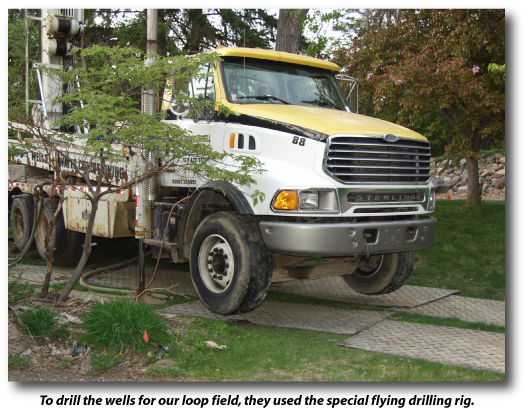 We have replaced our traditional furnaces, air conditioners, and water heater with a new system consisting of two geothermal heat pumps, a backup gas-fired furnace, a hot water storage tank, and a gas-fired on-demand hot water heater. The geothermal heat pumps both heat and cool the house using the soil under our yard as a gigantic heat sink (which is several times as efficient as a traditional furnace or air conditioner), and use waste heat to heat the water in the hot water storage tank. The on-demand hot water heater kicks in if the water in the tank isn't hot enough, and the gas-fired backup furnace is used on really cold days or when the power company turns off the heat pumps to manage the power grid in the winter.
First, a Rude Surprise
Recall that there are three financial incentives for installing this system:
- A $150/ton rebate from our electric company, Xcel energy, for new geothermal systems
- A "dual-fuel" electric rate which gives us cheaper electricity for the geothermal system if we have a gas backup and let the power company shut off the geothermal to manage the power grid, and
- A 30% federal tax credit
Of these, the $150/ton geothermal rebate from Xcel is relatively small (heat pump capacity, like air conditioner capacity, is measured in "tons." Our system is six tons total). The dual-fuel rate is the one which really makes the system work financially, since that makes the geothermal significantly cheaper to operate than natural gas, even in years when natural gas is cheap.
We calculated that, given the cost of replacing our old furnaces (which had to be done anyway) and taking advantage of all the financial incentives, the geothermal system would pay for itself in about nine years. That's not bad, considering that the heat pumps have a ten-year warranty and the loop field (the underground heat exchange wells which account for about half the project cost) should last pretty much forever.
Shortly after we committed to the project and paid for 50% of the system up front, we heard from our tax advisors that we might not actually be able to take advantage of the full geothermal tax credit. The problem is that the tax credit is nonrefundable, meaning that if it reduces your tax liability below zero then you don't get the difference back. At the time we were planning the system, it was still unclear if the credit would be refundable or not; and now that it's not, we don't know if we will have enough tax liability in 2009 to get the full value of the incentive.
We re-ran the numbers without the federal tax credit, and it turns out that without it the system will pay for itself in 18 years instead of nine. That's not great, but it's not terrible either, especially considering the nonfinancial benefits (helping the environment, etc.).
The System
The system we had installed is one of the more complicated (and therefore more expensive) residential geothermal systems out there. We had to work around two major limitations in our home: an addition with a completely separate furnace and air conditioner (and no practical way to tie the ductwork together into a single system), and a relatively cramped utility room. Our system consists of: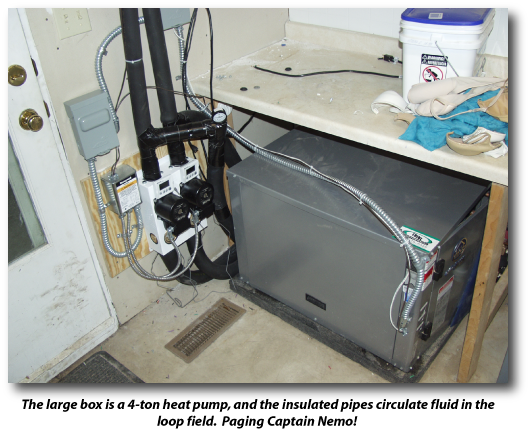
- The geothermal loop field, which is six parallel wells drilled to a depth of 180 feet in the front yard, each with a loop of pipe filled with antifreeze solution. A buried manifold connects the six loops to a pair of pipes which go underneath the garage into the utility room.
- A 2-ton heat pump for the addition, which uses antifreeze pumped through the loop field as a heat source or sink and an air conditioning-style compressor to heat or cool air. Some waste heat is pumped into the hot water storage tank through a pair of water pipes.
- A 4-ton heat pump for the main house, which pumps its refrigerant through a heat exchanger in the gas backup furnace to heat or cool the house. It also pumps waste heat into the hot water storage tank.
- A gas backup furnace, which also serves as the forced air blower for the main part of the house.
- A hot water storage tank, which is warmed up to about 110 degrees when the heat pumps are running (and stays cold when they're not).
- An on-demand hot water heater, which runs when the hot water in the storage tank isn't hot enough.
- A motley assortment of pipes, pumps, wires, fuseboxes, relays, etc.
Together, all this gear replaces everything which had been in our mechanical room except the water softener. It looks like the inside of Captain Nemo's submarine.
The Installation
The project took about two weeks to complete, though 90% of the work was finished in the first week. Drilling the loop field and replacing our old mechanical systems happened in parallel, with our new hot water heater and gas backup furnace operational after the first full day of work. This meant that we wouldn't have to be without heat or hot water, though fortunately the weather has been nice enough that the heat hasn't been necessary.
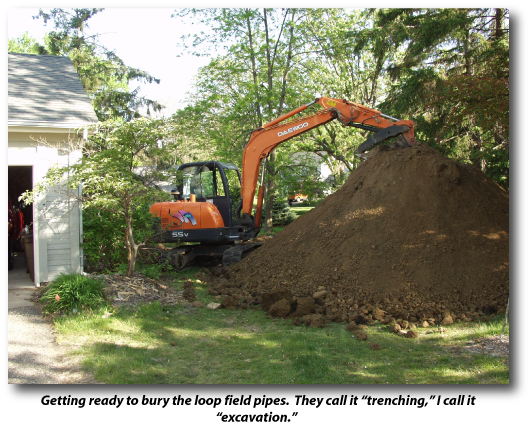 In order to be fully operational, after the equipment was in place and the loop field completed, the loop field had to be connected to the heat pumps and filled (it took about 125 gallons of an antifreeze mixture. I'm told this fluid should never have to be replaced, unless the system has to be drained for some reason). Then we had to wait for Xcel Energy to install a second electric meter, since the "dual fuel" rate requires that the geothermal system be separately metered from the rest of the house.
Once all that was done, we ran into a series of minor problems: the wrong part for a control relay, a burned out switch, and finally, after everything was running properly, the technicians accidentally left one of the heat pumps in a test mode, requiring another visit to reset it for normal functioning.
All told, the installation went about as well as can be expected for a project of this magnitude.
Living with Geothermal
The weather has been very pleasant lately, and we haven't used our new system much yet. It was a little cool the first evening the geothermal was on, so we ran it for a few hours to take the chill off.
Some things take getting used to in transitioning from traditional heat and air conditioning to geothermal. The biggest change is that unlike a gas furnace, which normally cycles on and off, a geothermal system is most efficient when it operates continuously in its lowest stage.
That means that it no longer makes sense to turn the heat down at night and when we're not at home during the day. We had saved a significant amount on our heating bill by turning the heat way down at night, but now that strategy will actually cost us money by forcing the geothermal system to run in a less efficient mode to catch up--or worse, the system might switch to the gas backup furnace, negating the efficiency of geothermal entirely.
Getting the most out of geothermal will mean making only very gradual changes to the temperature in the house. The name of the game is to try to keep it running in the lowest stage possible, and avoid running the gas backup at all. We'll have to experiment with it when we get into the next heating season to see what works, but I'm guessing that we can turn down the heat modestly during the work week, as long as we are careful to raise it only gradually on the weekend. The wood stove will be helpful, since it will give us a way to add more heating capacity without losing the benefit of the geothermal.
Our Geothermal Adventure (Chapter 2)
Sun, 04/19/2009 - 09:18 — Shivering TimbersWe've had a couple of months to investigate installing a geothermal heat pump system for our home, and now it's Decision Time.
This whole process started back in January when our old, conventional furnace went kaput on one of the coldest nights of the year. It was past its expected life expectancy, so we started researching geothermal. A geothermal heat pump uses the ground under the house as a gigantic heat sink, pumping heat underground in the summer (when the air conditioning runs), and pumping heat out in the winter (when it acts as a furnace). This takes considerably less energy than conventional heating and cooling.
Financially speaking, a geothermal system costs more upfront, but less to operate. The payback time is long enough that most people would be (understandably) reluctant to install one without some sort of financial incentive. Fortunately, there are incentives aplenty:
- The Fiscal Stimulus Package offers a 30% rebate to new EnergyStar rated geothermal installations from the federal government.
- Xcel Energy, our power company, offers a special "dual fuel" electric rate: if we have a conventional backup and let them turn off the electric heat pump occasionally to manage demand, they cut the electric rate in half.
- Xcel also offers a rebate of $150/ton for installing a new geothermal heat pump system.
Doing the Research; Running the Numbers
Going into this process, we were helped by the fact that my parents installed a geothermal system a little over a year ago. They've been generally happy with it, but had some issues (more on that later), and they were able to provide some hard numbers. We figured it would cost about $25,000 to replace our furnace.
We identified several local geothermal contractors and invited them to our home to inspect the existing system and offer ideas and bids. The contractors we did invite represented a cross-section of major heat pump brands, and all passed our initial screen of good histories on Angie's List. We did not talk to the installer my parents hired, after hearing some of their negative comments and seeing other customers' complaints.
Our home presents a couple of unique problems for this installation. First, we actually have two furnaces, separated by about 30 feet. One is for the main part of the house, and the other is for an addition built before we moved in. Ideally, we would want to replace both units with a single heat pump and tie the ductwork together, since a second heat pump adds considerable cost to the system. There also isn't very much room around either of the existing furnaces for new equipment, making it difficult to find room for a conventional gas backup furnace (and without that special electric rate, the numbers don't make sense).
None of the contractors we spoke to thought it was feasible to put in only a single heat pump to replace the two furnaces: there just is not enough room to run the needed ductwork without cutting through bearing walls.
The space constraints also knocked out one of the manufacturers, which simply didn't have any way to give us both the heat pump and the gas backup in the space we have available.
We settled on a system from a local WaterFurnace contractor with many years of experience, and which could show us examples of how they'd handled similar problems for other customers. The total cost will be about $40,000, and this will include two heat pumps, a natural gas backup furnace, a hot water holding tank, a desuperheater to use waste geothermal heat to preheat domestic hot water, and a whole-house on demand gas water heater. The cost is split approximately one-third for equipment, one-third for drilling the geothermal wells, and one-third for installation and other components.
This will be a six ton system total (heat pumps, like air conditioners, are measured in "tons" of capacity), with four tons serving the main part of the house, and two tons serving the addition. Only the main part of the house will get the backup gas furnace, but that will be sufficient to keep the addition warm (though not totally toasty).
Given that the total cost will be so much higher than we expected, we went back and did a more careful analysis of the payback. Working in our favor is that we are also getting a new water heater in the bargain (which we would probably need in a few years anyway), so we can count the avoided cost of a new water heater towards the geothermal system.
After figuring out the various rebates and backing out the cost of two new furnaces, two air conditioners, and a new water heater, we estimate that the geothermal system will cost about $11,000 more than replacing everything with the conventional equivalents (after rebates). It will save us about $900/year in heating costs, and $250/year in hot water (since the hot water will be essentially "free" when the geothermal system is running), and pay for itself in ten years.
I didn't figure in any air conditioning savings, since last summer we barely ran our A/C at all. However, if we do have a hot summer, the savings will increase very quickly because the efficiency improvement for geothermal air conditioning is even more dramatic than for geothermal heat. This could easily be hundreds of dollars more in savings.
So the numbers still make sense--the system will pay for itself before the warranty runs out.
That said, this will be a financial strain. First, we have to pay for the whole system in one big lump, whereas if we were to replace our furnaces, hot water heater, etc., as they failed, we would be spreading the cost out over several years. Second, we don't get the federal rebate (well over $10,000) until we get our 2009 tax refund sometime in 2010. That means that it will be over a year between the time we spend the money and when we get that part of the money back.
Finally, the $40,000 number doesn't include relandscaping the front yard. Drilling the wells will leave the yard a mess, and we're going to have to spend some money getting it repaired and cleaned up. We had been planning to do a some significant landscaping within the next few years, so this will also get moved up to this spring.
Avoiding the Pitfalls
Part of making the numbers work is making sure we actually can claim all the rebates and incentives for this project. My parents discovered this the hard way, when they went to do their 2008 taxes and learned that the model of heat pump they installed wasn't EnergyStar rated and therefore not eligible for the federal rebate. The rebate in 2008 was limited to $3,000, so they weren't counting on it to the same extent that we are, but it was a rude surprise nevertheless and a warning for our project.
I've verified that both of the heat pumps we'll be installing qualify for the federal rebate, but we still need to contact Excel and make sure we have all our ducks in a row for both of their programs.
I also expect that there will be some as-yet-unknown gotchas. We don't yet know where all our utility lines are, so we don't know where the wells can be drilled and where the connection to the house will have to go. There's the chance that something will turn out to be unsuitable and put the kabosh on the whole project.
The Plan
If all goes well we'll probably have our new system installed by the end of May. We need to get a permit for drilling the wells, and plan where everything will go. Drilling will be in early May, with the mechanicals shortly thereafter.
Our Geothermal Adventure (Chapter 1)
Wed, 02/25/2009 - 21:04 — Shivering TimbersA year ago my parents replaced their relatively new natural gas furnace with a geothermal system (or for the purists, a Ground Source Heat Pump, GSHP). They wanted to save energy and the environment, and saw this as a way to cut way back on their carbon footprint. They combined this with "windsource" electric service (which, at least in theory, supplies your electricity from wind farms at a slightly higher cost) in order to reduce their CO2 emissions from heating their home to effectively zero.
A geothermal (GSHP) system uses a heat pump (essentially a refrigerator which can be run in reverse) to extract heat from the ground in the winter, heating the house and cooling the ground. In the summer it runs the other way, extracting heat from the house to cool the house and warm the ground. A series of water-filled coils, the ground loop, act as a heat exchanger and turn the ground under the yard into a giant heat sink. The net result is heating and cooling 3-5 times as efficient as a traditional furnace.
My parents are happy with their system, but I had a hard time seeing how it made financial sense. Even with the higher efficiency, drilling a bunch of deep wells for the ground loop is a very expensive proposition, and natural gas is quite a bit cheaper than electricity.
Nevertheless, we decided that when the time came to replace our own furnace we would at least investigate geothermal.
That time came this winter, when the main furnace in our house (we have two) died on a cold night. It's 25 years old and past its expected lifetime, and when the technician looked at it his first question was whether we actually wanted to spend any money fixing it. We got it working again (at least for now) for a couple hundred dollars, and immediately started researching replacement options.
And so began the first chapter of Our Geothermal Adventure.
The Energy Equation
My first step was to call Dad and get some hard numbers from him about his geothermal system. Fortunately he keeps good records of utility bills, and was able to give me actual electricity and natural gas usage both pre- and post-geothermal. I could match those records against the records I kept of our bills from the same month to see how their heating costs compare to ours (answer: my parents' house uses about the same amount of heat as ours).
A little analysis showed that in my parents' home, the geothermal system heats their house for about a third as much energy as natural gas. This is as expected. However, at the rate we pay for electricity (about $0.11/kWh right now), electricity is two to three times as expensive as natural gas per BTU.
So in a year when gas is cheap (like this year), geothermal would cost about the same, and when gas is expensive we might save a third of our heating bill. That hardly seemed like enough of a difference to justify the huge upfront costs of the GSHP.
We decided to keep exploring anyway, since the environmental positives were appealing, even if the financial equation wasn't coming together.
Excelobama To The Rescue
About that time we learned that a geothermal tax credit was in the 2009 Stimulus Bill, as it was then going through congress. That would mean that the feds would pick up nearly a third of the cost of our installation if we decided to go down that route.
Then, at the first meeting with a geothermal salesperson, we learned that our local power company, Excel Energy, has a special "dual fuel" rate for people who heat with electricity (including geothermal) but have a fossil-fuel powered backup. The deal is that you let Excel turn off your electric heat as needed (an hour at a time, up to 24 hours over the course of the season) and they cut your electric rate in half for the power used for heating. This lets the power company better manage their load during the peak of heating season, and the backup furnace runs only a tiny fraction of the time.
The combination of these two factors--the Obama rebate and the Excel price cut--changed the math radically. Even compared to a year with cheap natural gas, our heating bill would be cut in half. If gas goes back to $1.50/therm (as it did after Katrina), we save 75% or more. And with the feds picking up 30% of the upfront cost, the payback for going geothermal got much faster.
In fact, when you look at the price difference between a geothermal system and a conventional furnace (remember, we have to replace the furnace anyway), we figure the geothermal will pay for itself within 7-10 years. That's actually before the warranty runs out from some manufacturers.
So it looks like we'll be getting a new geothermal system this summer. And this article can only end with....
To Be Continued....
